
Tuesday 18 November 2025 marked a significant moment for consumer law in the UK:
- The Competition and Markets Authority (CMA) published the final version of its Unfair Commercial Practices: Price transparency guidance (CMA 209), along with guidance on Getting consent for additional charges when selling online.
- The CMA also updated the broader Unfair commercial practices guidance (CMA 207) to reflect the new guidance on price transparency. This was originally issued in April 2025 to help traders to comply with the unfair commercial practices provisions in the Digital Markets Competition and Consumers Act 2024 (DMCCA).
- At the same time, the CMA announced that, as anticipated, it is taking active enforcement action against unfair online pricing practices, with an initial focus on drip pricing and pressure selling.
Even businesses that consider their pricing practices to be compliant may now fall within scope given that the CMA’s guidance takes a broad view, and its implications for consumer-facing operations are far-reaching.
What do businesses need to do?
Now is the time for consumer-facing businesses to review advertising materials and online interfaces, including purchase flows, to ensure compliance with price transparency rules.
The CMA has launched formal investigations against 8 companies and has written a further 100 advisory letters to businesses across 14 sectors.
Whilst the advisory letters do not constitute formal findings at this stage, the CMA has communicated that active sweeps of UK websites are underway to assess compliance with consumer protection law when displaying prices to consumers. The letters also have clear ‘Recommended Action’ to review consumer-facing websites to ensure pricing practices align with the DMCCA.
What has happened so far?
As a reminder, the unfair commercial practices regime under the DMCCA came into force in April 2025,at which time the CMA published its initial unfair commercial practices guidance to provide businesses with clarity on how the regime will operate. The CMA also published a document summarising the CMA’s expected approach to the regime in its first year (see our previous alert on this here).
However, following concerns raised by businesses regarding the practical implementation of the price transparency aspects of the regime, the CMA consulted further on additional specific guidance for price transparency issues. This latest final pricing transparency guidance (and consequential updates to existing guidance) is the outcome of that further consultation activity.
The CMA enforcement covers a range of online sales practices and dark patterns, including time-limited offers, pressure selling and default opt-ins, alongside misleading pricing. In this article we focus on drip pricing, which refers to the additional “hidden” charges that are dripped into the purchase throughout the checkout process. In these cases, a product is advertised at one price in an advert or on the homepage, however when the consumer goes to buy the product, various fees such as delivery charges or local taxes are added resulting in a final price which is different from that originally advertised.
What are the price transparency issues?
Traders are prohibited from engaging in drip pricing and must include all additional mandatory fees within the headline total price in any invitation to purchase to consumers. This covers anywhere that information is provided to consumers about a product and its price, including ads, product listings and the online purchase flow.
Where the additional mandatory fees cannot be quantified before the consumer starts the payment process, the headline price which is quantifiable must be accompanied with the information required for the consumer to be able to reasonably calculate the total price themselves.
We’ve summarised below some of the key practical points when it comes to implementing the requirements:
- Delivery charges and per-transaction charges:
- Delivery charges on an online order, as well as any per-transaction charges (such as a booking fee for cinema tickets), must always be included in the invitation to purchase and where calculable, the headline total price. Where a delivery charge is mandatory, it must be included in the headline total price.
- Optional delivery charges by contrast need not be included in a headline total price, but must still be included in an invitation to purchase.
- Where a delivery charge is mandatory but multiple delivery options are offered, the price of the cheapest option should be included in the headline total price, with more expensive options shown separately. Once a customer selects a more expensive delivery option, that price must be included in each subsequent part of the purchase flow.
- If free delivery is offered on purchases over a certain threshold, the cheapest standard delivery charge must be included up to the point when the customer’s basket exceeds that threshold.
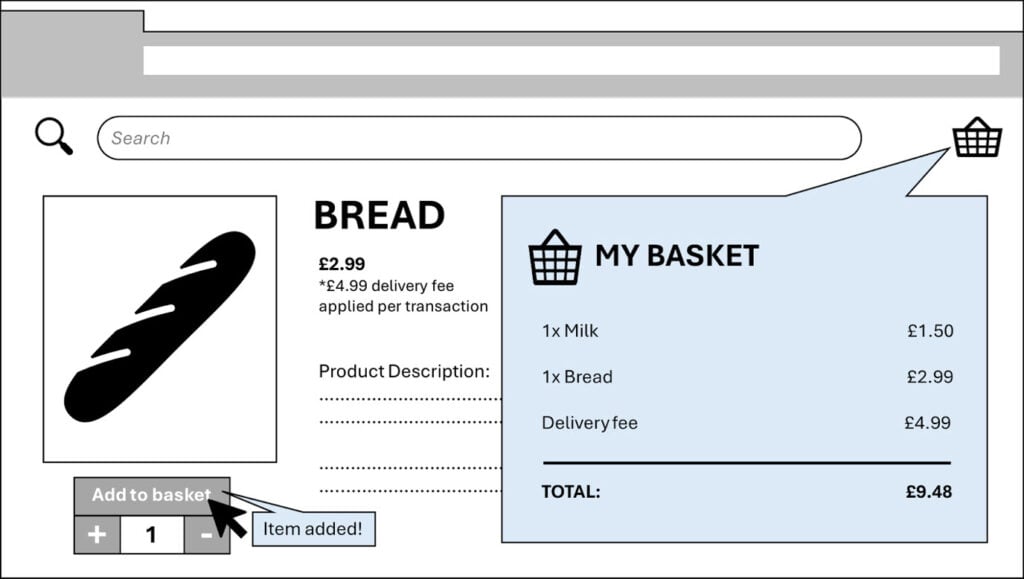
- This may present practical issues, for example where the delivery charge changes depending on the value of the products in the basket. The Guidance suggests that this can be addressed by presenting a running total list such as a prominent “floating basket” or “sticky banner” on the online webpage which remains in view as the customer scrolls. An example of a floating basket on an invitation to purchase can be seen in the image below. This is a key area where tech development is likely to be required in order to achieve compliance.
- Periodic contracts and subscriptions: Rolling contracts (where the consumer can cancel at any time) should display the total price for each ‘rolling period’, whilst the total price for fixed-term contracts can either be displayed as a cumulative total price over the entire contract length, or the total price per period payable, but alongside a prominent statement of the minimum contract period. There are further considerations where a one-time administrative fee is required.
- Optional charges: Optional charges need not be included in headline total prices where they are genuine ‘add-ons’. Whether a charge is mandatory or optional depends on whether the transaction can take place without the additional charge facilitating it – if not, then it is a mandatory charge and must be included in the headline total price. Such mandatory charges may include VAT, administrative or service fees, cleaning fees, local taxes, etc.
- Products sold by weight/length etc.: If it is not possible to calculate a headline total price without further information from the customer due to the nature of the product or service (such as weight, length, duration or distance), the trader must provide the consumer with sufficient information to calculate this themselves. The example given is made-to-measure curtains. Such additional information provided alongside a headline total price must be displayed with “equal prominence” to the headline total price.
How does the UK position on pricing practices compare to the EU?
Whilst the underlying position under the UK DMCCA requiring the display of headline total prices broadly aligns with the EU Unfair Commercial Practices Directive (UCPD), this updated UK regime on price transparency now goes further. In practice we expect many businesses will want to retain a standardised approach across the UK and EU but divergence is emerging. Notably, the proposed EU Digital Fairness Act (DFA) signals a move towards tackling drip pricing and other manipulative online practices in a similar way. There are indications that the DFA will require businesses to present the total price upfront, including all unavoidable charges such as delivery fees, service charges, and taxes, mirroring the UK DMCCA but framed under a broader ‘digital fairness’ agenda. The DFA also aims to regulate algorithmic pricing and unfair personalisation with updated rules on transparency and unfair practices. While the UCPD already prohibits misleading pricing, the DFA will strengthen enforcement and introduce specific prohibitions in digital environments.
Next steps
As these regimes evolve, businesses selling to consumers face the challenge of navigating growing divergence between UK and EU requirements while maintaining a consistent, compliant approach across markets. Drawing on experience across UK and EU consumer law, we will continue to share our practical insights to help organisations stay ahead of regulatory developments.
Proactive compliance is key. Reviewing pricing and UX practices, identifying and closing gaps, and engaging constructively with regulators can help prevent issues before they escalate.
If you’d like to explore practical ways to strengthen your approach, the Baker McKenzie Consumer Law Team is here to support you.